If you’ve ever wondered, “What does LGBTQIA+ stand for?” you’re not alone. The term appears in news headlines, social media bios, workplace policies, Pride events, and everyday conversations.
People search for this phrase because they want clarity. Some want to understand a loved one better. Others are exploring their own identity. Many simply want to use the right words respectfully.
Here’s a complete, accurate, and culturally informed explanation — covering definition, history, emotional meaning, real-life examples, variations, and global perspectives.
Definition & Core Meaning of LGBTQIA+
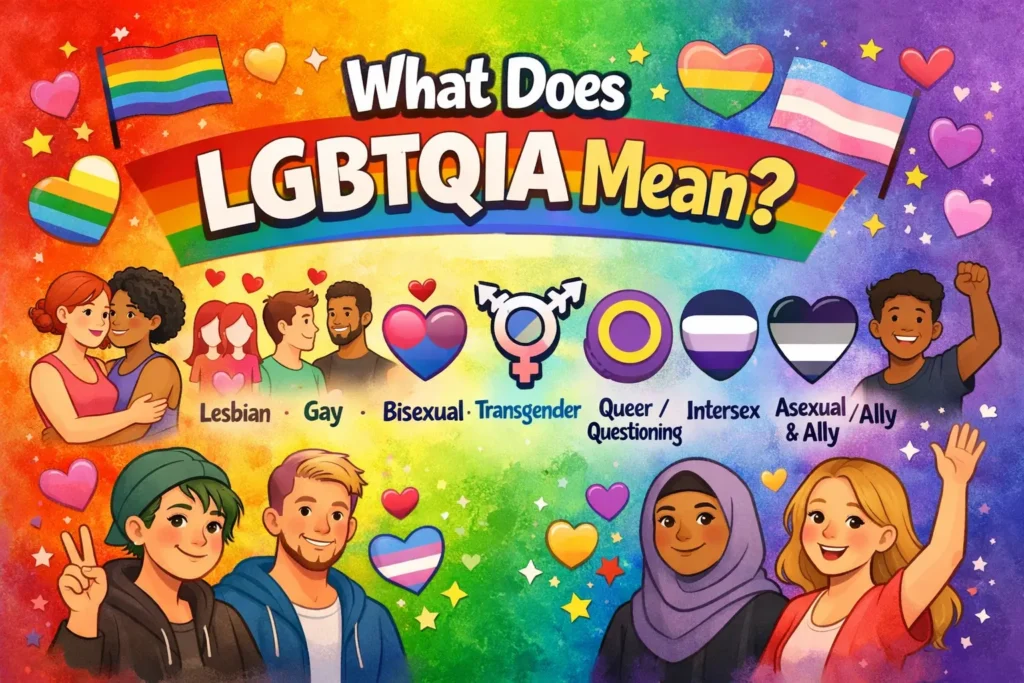
At its core, LGBTQIA+ is an umbrella acronym representing diverse sexual orientations, gender identities, and expressions.
Each letter stands for:
- L – Lesbian: A woman attracted to other women.
- G – Gay: A person attracted to people of the same gender (often used for men, but can be broader).
- B – Bisexual: A person attracted to more than one gender.
- T – Transgender: A person whose gender identity differs from their sex assigned at birth.
- Q – Queer or Questioning:
- Queer: A reclaimed term for people who are not heterosexual or cisgender.
- Questioning: Someone exploring their identity.
- I – Intersex: A person born with biological traits (chromosomes, hormones, anatomy) that don’t fit typical definitions of male or female.
- A – Asexual / Aromantic / Agender:
- Asexual: Experiences little or no sexual attraction.
- Aromantic: Experiences little or no romantic attraction.
- Agender: Does not identify with a gender.
- + (Plus): Represents other identities not explicitly listed.
Simple Examples
- “She identifies as bisexual, so she’s part of the LGBTQIA+ community.”
- “They are transgender and use they/them pronouns.”
- “He’s questioning and still figuring things out.”
The acronym evolves over time as understanding grows.
Historical & Cultural Background
4
The concept of diverse sexual orientations and gender identities is not new. What’s new is the language used to describe them.
Ancient Civilizations
- In ancient Greece and Rome, same-sex relationships were documented in literature and art.
- Many Indigenous cultures recognized more than two genders. For example, the concept of “Two-Spirit” in some Native American traditions predates colonial influence.
- South Asia historically recognized third-gender communities, such as hijras.
Modern Activism
The modern LGBTQ+ rights movement gained global attention after the 1969 uprising at the Stonewall Inn in New York City. This event marked a turning point in LGBTQ+ activism.
In 1978, artist Gilbert Baker created the first rainbow Pride flag — now an international symbol of diversity and unity.
Since then, awareness, legal protections, and social acceptance have expanded in many regions, though challenges remain worldwide.
Emotional & Psychological Meaning
Beyond definitions, LGBTQIA+ represents:
1. Identity
For many, the acronym provides language to understand themselves.
2. Belonging
It offers community, especially for people who felt isolated growing up.
3. Healing
Recognizing one’s identity can reduce shame and internal conflict.
4. Self-Expression
It empowers individuals to live authentically.
Psychologically, being able to name one’s identity often leads to increased confidence, lower anxiety, and improved well-being — particularly when supported by community.
See also: What Does Gender Identity Mean?
Different Contexts & Use Cases
1. Personal Life
People use LGBTQIA+ when describing themselves or loved ones:
- “My sister is part of the LGBTQIA+ community.”
- “I identify as queer.”
2. Social Media
Common examples:
- Rainbow emojis 🌈
- Pronouns in bios (she/her, they/them)
- Hashtags like #LGBTQIAPlus or #Pride
3. Relationships
The term helps clarify orientation and gender identity in dating contexts.
Example:
- “He’s gay, so he dates men.”
- “They’re nonbinary and prefer gender-neutral language.”
4. Professional & Workplace Usage
Many companies include LGBTQIA+ inclusion in diversity policies. You might see:
- LGBTQIA+ employee resource groups
- Inclusive healthcare policies
- Anti-discrimination statements
Hidden, Sensitive, or Misunderstood Meanings
1. It’s Not Just About Sexuality
Some letters (like T and I) relate to gender identity or biological traits — not sexual orientation.
2. The “Q” Word
“Queer” used to be a slur. Many have reclaimed it, but context matters. Some older individuals may still find it offensive.
3. The “+” Is Important
It acknowledges that identity is diverse and evolving.
4. Not Everyone Uses the Full Acronym
Some prefer:
- LGBTQ+
- LGBT
- Queer community
Language varies depending on region and generation.
Comparison Table: LGBTQIA+ vs Related Terms
| Term | What It Refers To | Includes Gender Identity? | Includes Sexual Orientation? |
|---|---|---|---|
| LGBTQIA+ | Broad umbrella community | Yes | Yes |
| LGBT | Shorter version | Yes | Yes |
| Queer | Reclaimed umbrella term | Yes | Yes |
| Sexual Orientation | Attraction pattern | No | Yes |
| Gender Identity | Internal gender sense | Yes | No |
Key Insight:
LGBTQIA+ is an inclusive umbrella term that covers both gender identity and sexual orientation, making it broader than most related terms.
Popular Types & Variations (10+)
Here are common identities within or related to LGBTQIA+:
- Pansexual – Attracted to people regardless of gender.
- Nonbinary – Does not identify strictly as male or female.
- Genderfluid – Gender identity changes over time.
- Demisexual – Attraction occurs only after emotional connection.
- Polysexual – Attracted to multiple (but not all) genders.
- Bigender – Identifies as two genders.
- Two-Spirit – Indigenous identity blending gender and spiritual roles.
- Graysexual – Experiences rare or limited attraction.
- Agender – Identifies as having no gender.
- Aromantic – Experiences little or no romantic attraction.
- Transmasculine – Assigned female at birth, identifies more masculine.
- Transfeminine – Assigned male at birth, identifies more feminine.
These identities may or may not appear directly in the acronym but are included under the “+”.
How to Respond When Someone Asks About It
Casual Response
“It stands for different sexual orientations and gender identities.”
Meaningful Response
“It’s an umbrella term representing people who aren’t heterosexual or cisgender.”
Fun Response
“It’s basically the alphabet of identity and diversity — and the plus means there’s always room for more.”
Private or Respectful Response
“If you’re asking because you’re curious about yourself, take your time. Labels are tools, not pressure.”
Tone matters. Be respectful, calm, and open.
Regional & Cultural Differences
4
Western Countries
North America and parts of Europe have strong Pride movements and legal protections, though debates continue.
Asian Context
Some countries are more conservative socially, while others (like Taiwan) recognize same-sex marriage.
Middle Eastern Context
LGBTQIA+ identities exist but may face legal or social challenges.
African & Latin Regions
Acceptance varies widely by country, culture, religion, and politics.
Despite differences, LGBTQIA+ individuals exist in every culture and era.
FAQs About LGBTQIA+
1. What does the “+” in LGBTQIA+ mean?
It includes identities not specifically named in the acronym.
2. Is LGBTQIA+ the same as LGBT?
LGBT is a shorter version. LGBTQIA+ is more inclusive.
3. Is “queer” offensive?
It depends on context and generation. Many use it proudly; some still find it hurtful.
4. Does LGBTQIA+ only refer to sexual orientation?
No. It includes gender identity and biological diversity as well.
5. Can someone be questioning and still belong?
Yes. Exploring identity is valid.
6. Why does the acronym keep changing?
Language evolves as understanding grows.
7. Is it necessary to memorize every term?
No. Respect and openness matter more than perfect vocabulary.
Conclusion
So, what does LGBTQIA+ stand for?
It’s more than an acronym. It represents diversity, identity, resilience, and community. Each letter tells a story — of history, struggle, self-discovery, and pride.
Understanding the term builds empathy. Using it correctly shows respect. And recognizing its depth reminds us that identity is personal, complex, and worthy of dignity.
At its heart, LGBTQIA+ means this: people deserve to live authentically and safely as themselves.