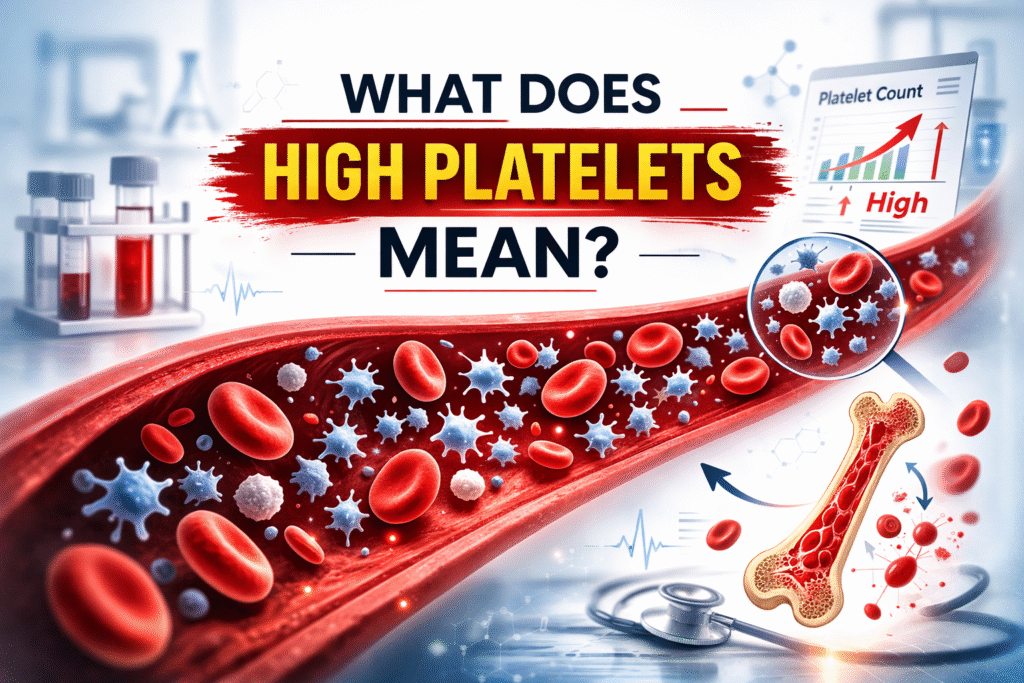
You just received a blood test report, and one line caught your attention: High Platelets.
Now you’re wondering — what does high platelets mean? Is it dangerous? Is it temporary? Does it signal something serious?
High platelets, medically known as thrombocytosis, can have simple explanations — like an infection — or more complex ones involving bone marrow disorders. The meaning depends on context, symptoms, and overall health.
Here’s a clear, practical breakdown of what high platelets mean, why they happen, and what to do next.
Definition & Core Meaning
High platelets refer to a platelet count above the normal range in a complete blood count (CBC) test.
Platelets (also called thrombocytes) are small blood cells that help your blood clot and stop bleeding.
📊 Normal vs High Platelet Count
- Normal range: 150,000 to 450,000 platelets per microliter of blood
- High platelets (thrombocytosis): Above 450,000 per microliter
What Does High Platelets Mean?
High platelets can indicate:
- Reactive (Secondary) Thrombocytosis
- Caused by another condition
- Usually temporary
- Example: “My platelets are high because I recently had surgery.”
- Primary Thrombocytosis (Essential Thrombocythemia)
- A bone marrow disorder
- Platelets are overproduced
- May increase clotting risk
- Inflammatory Response
- Body reacting to infection or trauma
- Example: “My doctor said the infection caused my platelets to rise.”
- Iron Deficiency
- Surprisingly, low iron can trigger higher platelet production
In simple terms: High platelets usually mean your body is reacting to something — but sometimes it signals a blood disorder.
Understanding Platelets Visually
4
These images show:
- What platelets look like under a microscope
- How platelet levels appear in lab reports
- Where platelets are made (bone marrow)
- How platelets form clots to stop bleeding
Historical & Medical Background
The understanding of platelets evolved significantly in modern hematology.
In the late 19th century, scientists began identifying platelets as distinct blood components. The term thrombocyte comes from Greek roots meaning “clot cell.”
Modern classifications are guided by organizations like the:
- World Health Organization
- American Society of Hematology
Today, thrombocytosis is divided into:
- Reactive (secondary)
- Primary (clonal or essential thrombocythemia)
Advances in molecular genetics — especially the discovery of the JAK2 mutation — helped doctors better diagnose bone marrow–related platelet disorders.
Emotional & Psychological Meaning
While high platelets are a medical condition, the emotional impact can be significant.
Seeing abnormal lab results can trigger:
- Anxiety
- Fear of blood cancer
- Health-related stress
- “Worst-case scenario” thinking
Psychologically, lab results often feel more serious than they are. Most high platelet cases are reactive and temporary.
The key mindset shift:
Abnormal doesn’t automatically mean dangerous.
Understanding the cause reduces fear and improves decision-making.
Different Contexts & Use Cases
1️⃣ Personal Health Context
When someone says, “My platelets are high,” they usually mean:
- A recent blood test showed elevated levels
- Their doctor is investigating the cause
- Monitoring is required
2️⃣ Clinical Context
Doctors use high platelets to:
- Detect inflammation
- Monitor post-surgery recovery
- Identify bone marrow disorders
- Evaluate clotting risk
3️⃣ Emergency Context
Extremely high platelet levels (above 1,000,000 per microliter) may increase risk of:
- Blood clots (thrombosis)
- Stroke
- Deep vein thrombosis
- Pulmonary embolism
But this is uncommon and usually linked to underlying disorders.
4️⃣ Modern Health Conversations
People often Google:
- “Is high platelets serious?”
- “Can stress cause high platelets?”
- “What foods lower platelet count?”
This shows growing awareness of preventive health.
See also: What Does Low Hemoglobin Mean?
Hidden, Sensitive, or Misunderstood Meanings
❌ Myth 1: High platelets always mean cancer
Not true. Most cases are reactive.
❌ Myth 2: It’s always dangerous
Mild elevation often resolves without treatment.
❌ Myth 3: Diet alone causes it
Diet can influence blood health but rarely causes extreme platelet elevation.
❌ Myth 4: You’ll always have symptoms
Many people with high platelets feel completely normal.
When It’s More Serious
High platelets may require deeper evaluation if:
- There’s no obvious infection or cause
- Levels remain high for months
- You experience clotting symptoms
- You have unexplained headaches or vision changes
Persistent elevation may indicate Essential Thrombocythemia, a rare bone marrow disorder.
Comparison Table: High Platelets vs Related Blood Conditions
| Condition | Platelet Level | Main Cause | Clot Risk | Severity |
|---|---|---|---|---|
| Reactive Thrombocytosis | High | Infection, inflammation | Low–Moderate | Usually temporary |
| Essential Thrombocythemia | Very High | Bone marrow disorder | High | Chronic condition |
| Low Platelets (Thrombocytopenia) | Low | Immune or marrow issues | Bleeding risk | Can be serious |
| Polycythemia Vera | High RBCs | Bone marrow mutation | High | Chronic |
| Leukocytosis | High WBCs | Infection or stress | Depends | Varies |
🔎 Key Insight:
High platelets alone don’t define severity — cause and duration matter more than the number itself.
Popular Types / Variations of High Platelets (8–10)
- Reactive Thrombocytosis
Triggered by infection, surgery, trauma. - Essential Thrombocythemia
Chronic bone marrow disorder. - Post-Splenectomy Thrombocytosis
After spleen removal, platelets increase. - Iron-Deficiency–Related Thrombocytosis
Low iron stimulates platelet production. - Inflammatory Thrombocytosis
Caused by autoimmune diseases like rheumatoid arthritis. - Cancer-Associated Thrombocytosis
Some cancers stimulate platelet production. - Stress-Related Elevation
Temporary spike due to physiological stress. - Medication-Induced Thrombocytosis
Certain drugs stimulate platelet growth. - Chronic Inflammatory Thrombocytosis
Long-term inflammatory conditions. - Genetic Mutation–Linked Thrombocytosis
Associated with JAK2, CALR, or MPL mutations.
Symptoms of High Platelets
Many people have no symptoms.
When symptoms appear, they may include:
- Headaches
- Dizziness
- Chest pain
- Tingling in hands/feet
- Fatigue
- Visual disturbances
- Unexplained clotting
Severe cases may cause:
- Stroke
- Heart attack
- Deep vein thrombosis
Symptoms depend on the underlying cause, not just the platelet count.
How Doctors Diagnose the Cause
Diagnosis may include:
- Repeat CBC test
- Iron studies
- Inflammation markers (CRP, ESR)
- Bone marrow biopsy (if needed)
- Genetic testing for JAK2 mutation
Doctors look for patterns, not just numbers.
Treatment Options
Treatment depends on cause.
For Reactive Thrombocytosis:
- Treat infection
- Correct iron deficiency
- Monitor levels
Usually no direct platelet-lowering treatment is needed.
For Essential Thrombocythemia:
- Low-dose aspirin
- Platelet-lowering medication (e.g., hydroxyurea)
- Regular monitoring
Lifestyle also matters:
- Stay hydrated
- Exercise regularly
- Avoid smoking
- Manage inflammation
How to Respond When Someone Asks About It
Casual Response
“My blood test showed high platelets — probably from a recent infection.”
Meaningful Response
“My platelets are elevated, so my doctor is checking for inflammation or iron deficiency.”
Fun Response
“Apparently my blood is extra enthusiastic about clotting!”
Private Response
“It’s something I’m monitoring with my doctor.”
Regional & Cultural Differences in Understanding
Western Medicine
Focused on lab-based diagnosis and genetic testing.
Asian Medicine
Traditional systems may interpret it as imbalance in blood heat or inflammation.
Middle Eastern Perspectives
Emphasis on dietary balance and inflammation management.
African & Latin Communities
Greater concern due to limited access to regular testing — often discovered during unrelated exams.
Globally, awareness is increasing thanks to preventive healthcare trends.
FAQs About High Platelets
1. Is high platelets dangerous?
Usually not. It depends on cause and how high the level is.
2. Can stress cause high platelets?
Temporary stress can raise levels slightly, but persistent elevation needs evaluation.
3. Can dehydration affect platelet count?
Yes. Dehydration can concentrate blood components and slightly elevate counts.
4. What foods lower platelet count?
There’s no guaranteed food fix, but anti-inflammatory diets may help overall blood health.
5. When should I worry?
If levels remain high for months or you develop clotting symptoms.
6. Can high platelets turn into cancer?
Reactive thrombocytosis does not turn into cancer. Essential thrombocythemia is a chronic disorder but often manageable.
7. How long does it take for platelets to normalize?
Reactive cases may normalize within weeks after treating the underlying cause.
Conclusion
So, what does high platelets mean?
In most cases, it means your body is reacting to something — infection, inflammation, iron deficiency, or recovery from surgery.
Only a small percentage of cases involve bone marrow disorders like essential thrombocythemia.
The number alone doesn’t tell the full story. Context, symptoms, and medical evaluation matter more than a single lab result.
Understanding your platelet count empowers you to ask better questions, reduce anxiety, and take informed action.
Health is rarely about one number. It’s about patterns, balance, and perspective.