The symbol ~, often called the tilde, is small but surprisingly powerful. People search for “what does ~ mean” because they see it everywhere—on social media, in math, coding, texting, usernames, and even casual conversation—and its meaning seems to change depending on context.
Sometimes it means approximately. Other times it adds a playful tone, softens a message, or hints at something unsaid. That flexibility is exactly why it confuses so many people.
This guide breaks down the definition, usage, examples, and slang meanings of ~ in a way that’s easy to understand but still deep enough for advanced users. By the end, you’ll know exactly how and when to use it with confidence.
Definition & Core Meaning of ~
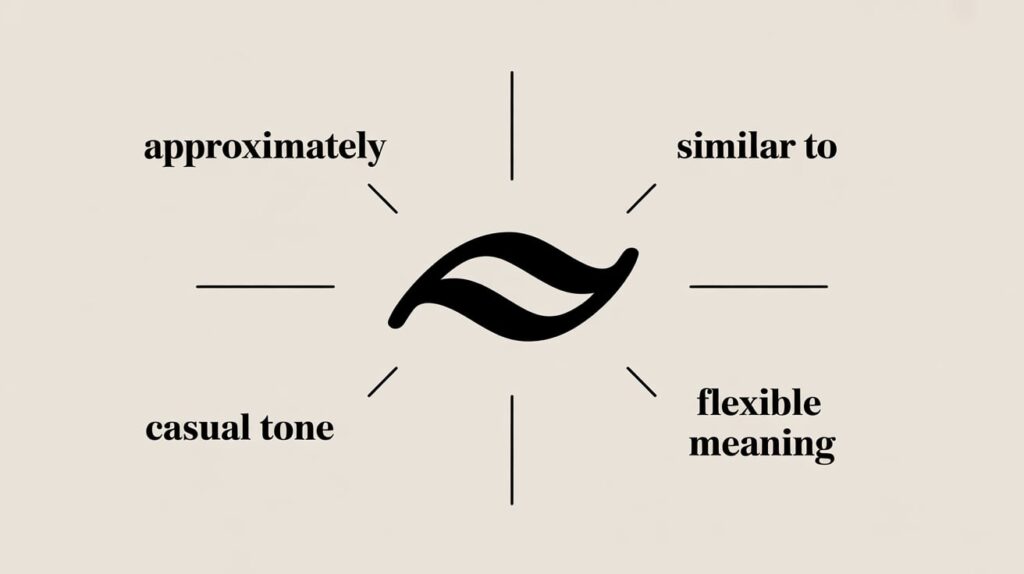
At its core, the ~ (tilde) symbol represents approximation, similarity, or a relaxed tone, depending on how and where it’s used.
Primary Meanings of ~
- Approximation – “around,” “about,” or “roughly”
- Similarity or equivalence – “similar to” or “related to”
- Casual tone marker – softens or lightens a statement
- Continuation or implication – something left open or implied
Simple Examples
- “The meeting will start at ~5 PM.”
- “His style is ~90s inspired.”
- “Sure~ I guess we can do that.”
Each example uses the same symbol, but the meaning shifts based on context.
Historical & Cultural Background
The tilde has a long and fascinating history that adds credibility to its modern usage.
Ancient Origins
- The symbol dates back to Latin manuscripts, where scribes used it as shorthand to indicate missing letters.
- It was a space-saving mark, not decoration.
Western Usage Evolution
- In mathematics, it evolved to mean approximation or equivalence.
- In linguistics, it marks nasal sounds (like ñ in Spanish).
- In technology, it became part of programming and file systems.
Asian Digital Culture Influence
- In Japanese online culture, ~ is used to add friendliness or emotional warmth.
- It can suggest a sing-song tone, friendliness, or playful teasing.
Indigenous & Symbolic Views
- Wavy lines similar to ~ have long symbolized flow, water, and continuity in indigenous art.
- This symbolic meaning aligns closely with modern emotional usage.
Emotional & Psychological Meaning of ~
Beyond technical definitions, ~ carries emotional weight.
Softening Communication
Using ~ can make a sentence feel:
- Less aggressive
- Less final
- More approachable
Example:
- “You’re late.” (direct)
- “You’re late~” (gentler, teasing)
Identity & Self-Expression
People often use ~ to:
- Show a relaxed personality
- Signal friendliness
- Avoid sounding cold or robotic
Mindset & Symbolism
Psychologically, ~ suggests:
- Flexibility over rigidity
- Openness instead of finality
- Flow instead of control
This is why it appears often in healing, journaling, and reflective writing.
Different Contexts & Use Cases
Personal Life
- Used to soften everyday statements
- Adds warmth in casual notes or messages
Example:
- “I’ll call you later~”
Social Media
- Signals tone that text alone can’t express
- Common in captions, bios, and replies
Example:
- “Living my best life~ 🌿”
Relationships
- Can feel flirty, playful, or affectionate
- Often used in light teasing
Example:
- “You miss me already~”
Professional & Modern Usage
- In emails, it’s informal and should be used carefully
- Common in creative fields or internal chats
Example:
- “The project will take ~3 weeks.”
Hidden, Sensitive, or Misunderstood Meanings
What People Get Wrong
- Thinking ~ always means approximation
→ In texting, it often signals tone, not numbers.
Cultural Misinterpretations
- In some cultures, ~ may seem unprofessional.
- In others, it’s seen as friendly and expressive.
When Meaning Changes
- One ~ can feel playful.
- Multiple ~~~ can feel sarcastic or exaggerated.
Context always matters.
Comparison Section
| Symbol | Meaning | Usage Context |
|---|---|---|
| ~ | Approximate / playful | Math, texting, tone |
| ≈ | Approximately equal | Mathematics only |
| … | Continuation | Writing, storytelling |
| – | Neutral separator | Lists, ranges |
| 🙂 | Friendly emotion | Messaging |
| ! | Emphasis | Excitement, urgency |
Key Insight:
Unlike other symbols, ~ blends logic and emotion, making it uniquely versatile.
Popular Types & Variations of ~ (With Meanings)
- Single Tilde (~)
Basic approximation or tone softener. - Double Tilde (~~)
Playful exaggeration or teasing. - Trailing Tilde (word~)
Casual, friendly ending. - Leading Tilde (~word)
Informal emphasis or style choice. - Numeric Tilde (~10)
Rough estimate. - Stylistic Tilde
Used in usernames or bios for aesthetic flow. - Flirty Tilde
Adds charm or teasing tone. - Sarcastic Tilde
Depends heavily on context. - Coding Tilde
Represents home directories or negation. - Decorative Tilde
Used purely for visual balance.
How to Respond When Someone Asks About ~
Casual Responses
- “It just means ‘around’ or ‘kind of.’”
- “It softens the message.”
Meaningful Responses
- “It shows flexibility or an open-ended idea.”
- “It adds tone that plain text lacks.”
Fun Responses
- “It’s the chill version of punctuation.”
- “It’s a vibe, not a rule.”
Private or Professional Responses
- “It indicates approximation or informal tone.”
- “It’s context-dependent.”
Regional & Cultural Differences
Western Cultures
- Common in math, tech, and casual writing
- Seen as informal but acceptable
Asian Cultures
- Widely used in digital communication
- Often conveys friendliness or warmth
Middle Eastern Contexts
- Less common in casual writing
- More technical or symbolic usage
African & Latin Cultures
- Gaining popularity through social media
- Often aesthetic or expressive
Frequently Asked Questions (FAQs)
What does ~ mean in texting?
It softens tone or adds a playful, friendly feeling.
Does ~ always mean approximately?
No. In casual communication, it often signals emotion or openness.
Is it professional to use ~?
In formal writing, avoid it. In casual or internal communication, it’s fine.
Why do people use ~ at the end of sentences?
To make the message feel relaxed or less harsh.
Is ~ flirty?
It can be, depending on context and relationship.
What does ~~ mean?
Usually exaggeration, teasing, or extra playfulness.
Is ~ used differently in coding?
Yes. In programming, it has specific technical meanings.
See also: What Does ≈ Mean in Math and Everyday Language
Conclusion
The ~ symbol may look simple, but its meaning is layered, flexible, and deeply human. It bridges logic and emotion, precision and personality. Whether it’s estimating time, softening a message, or adding warmth to digital communication, ~ adapts to context like few symbols can.
Understanding what ~ means helps you communicate more clearly—and more authentically. Once you notice it, you’ll see it everywhere, quietly shaping tone and meaning.